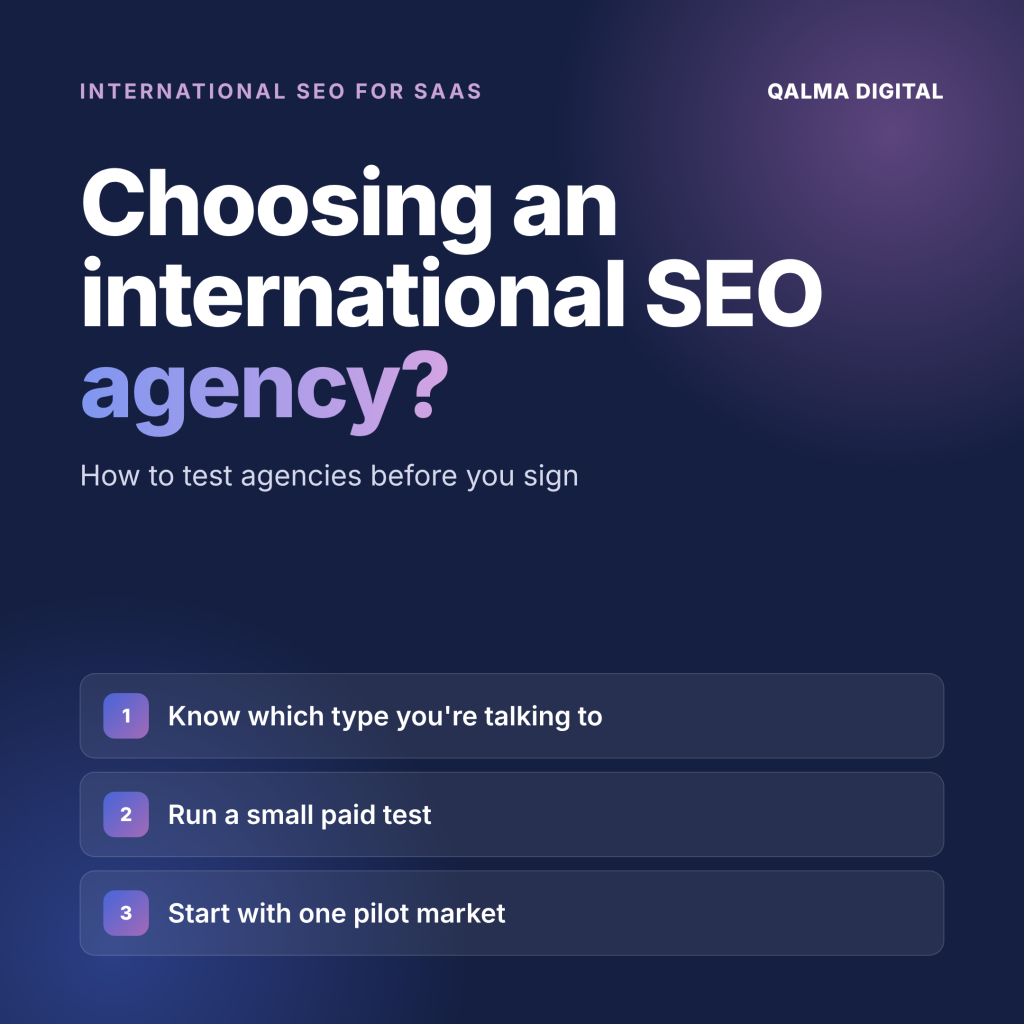
Short answer: The most reliable way to choose an international SEO agency for SaaS is to test it before you sign. Know which type of agency you’re talking to, give the shortlist a small paid task in one target market, ask for a proposal that is planned and priced per market, and start with one pilot market before rolling out to the rest. An agency that understands local search intent shows it in the test.
An international SEO agency helps a company rank in search results in more than one country or language. Its work covers the site’s technical setup for each market, local keyword research and content in each language, and building authority where the company wants to grow.
By the time a SaaS company starts looking for one, it usually has three proposals that sound alike. Each promises local keyword research, native-speaking experts and reporting per market. The differences tend to show months later: the German blog ranks for terms nobody in Germany searches for, the Spanish content reads like a translation, or the monthly report counts brand searches from a paid campaign as SEO results.
This guide is about avoiding that. It covers how to tell the main types of agencies apart, how to test them before signing, what to ask for in the proposal and from references, and what to watch in the first months.
Four types of international SEO agencies, and where each one can slip
Generalist SEO agencies that add other languages through translators usually have strong processes and technical skills in their home market. The risk sits in the other languages: content is often planned in English and translated, so the keyword research may start from a translated list. Ask who researches keywords in each language, and how.
Networks of local agencies bring real knowledge of each country, because a lead agency coordinates partners on the ground. The risk is consistency. Quality, priorities and reporting can differ from market to market, so ask who owns the overall strategy and whether you’ll get one report or five.
Technical international SEO specialists are strongest on hreflang, site structure and migrations, the part Google’s documentation on managing multi-regional and multilingual sites covers. Content is often not their focus, so once the setup is fixed, someone still needs to write pages that buyers in each market search for.
Content-led agencies work with native-speaking writers and start every market with local keyword research. Their focus is what gets published in each language and whether it ranks and converts. Ask how they work with whoever owns the technical side of the site.
Many SaaS companies end up combining two of these, typically a technical partner or an in-house SEO lead for the setup and a content partner for each market. The guide to content localization agencies for SaaS compares the content-focused providers in more detail.
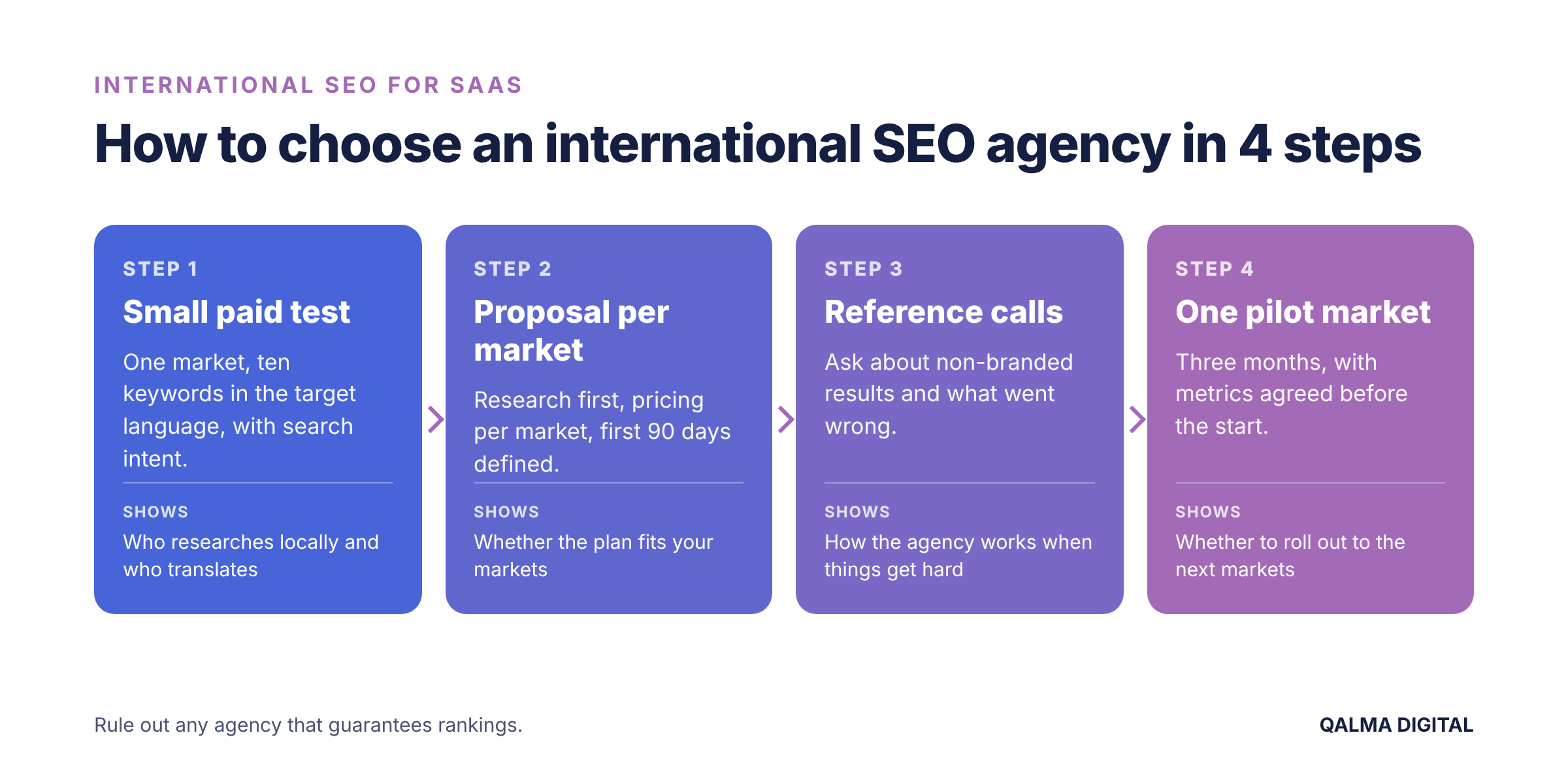
Step 1: Give the shortlist a small paid test
Sales calls show how an agency presents itself. A small paid task shows how it works. Pick one target market and one product category, and ask each shortlisted agency for ten keywords in the target language that buyers use when they’re close to choosing a tool, the search intent behind each one and the type of page that ranks for it today, and one example where the local search term differs from a direct translation of the English one. Keep the task small enough to finish in a week.
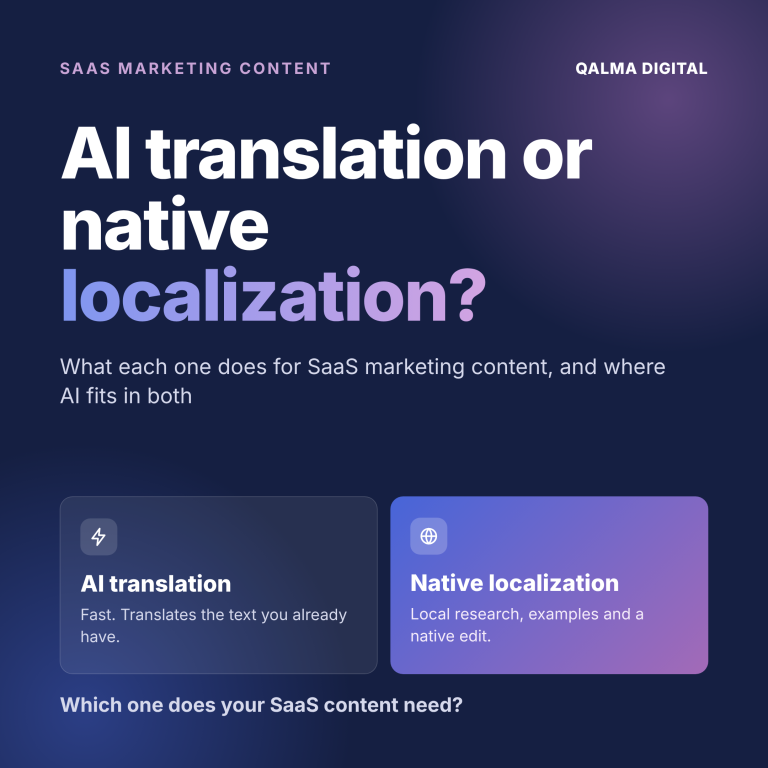
Then compare the results side by side, ideally with a native-speaking colleague or customer from that market. International SEO keyword research done in the target language turns up terms your English keyword list doesn’t contain: colloquial phrases, English loanwords that buyers keep, spellings without accent marks. An agency that translates returns your own list in another language. For more on why that matters, see AI translation vs. native content localization.
Step 2: Ask for a proposal planned per market
A proposal for international SEO should treat each market as its own project. Research comes before the content plan, so the first month of each market should include keyword and competitor research in the local language, and the content calendar should follow from it. If the proposal already lists the same article topics for every country, the research hasn’t been done yet.
Pricing should be broken down by market, with a clear answer to what an additional market costs. The first 90 days should have concrete deliverables: the research, a technical review, the first published pages and the first report. The proposal should also say who is responsible for hreflang and the URL structure, who writes and who reviews in each language, who owns the content once it’s published, and what the minimum term and exit conditions are. For a benchmark, SEO agencies in Ahrefs’ survey of 439 providers charged $3,209 a month on average, and how much content localization costs breaks down the pricing models for the content side.
One promise should end the conversation: guaranteed rankings. Google’s own guidance on hiring an SEO says plainly that no one can guarantee a #1 ranking on Google.
Step 3: Ask references the questions that matter
A reference call is only useful if the questions go beyond satisfaction. These four tend to get honest answers:
- How much did non-branded organic traffic change in the markets the agency worked on, and how was it measured?
- Who did the work in your language, and did that change during the project?
- What went wrong at some point, and how did the agency handle it?
- How long did it take before organic search brought the first leads in the new market?
The third question is the most revealing. Every project has problems, and how an agency talks about them says more than any case study.
Step 4: Start with one pilot market
Rolling out five markets at once makes it hard to tell what works. A single pilot market for three months, with metrics agreed before the start, gives a clear basis for the next decision. Choose the market where local keyword research confirms demand for the product category and where the product and sales team can already serve customers.
Agree in advance on what the pilot should show: non-branded impressions and rankings for target keywords in the first months, visibility in Google’s AI features, and the first leads from organic search. How to measure the ROI of multilingual content covers how to set this up per market, including how to filter out brand searches.
What usually goes wrong after signing
The most common problem is a keyword map built from translated English terms. It produces pages that are accurate and well written, and that rank for searches nobody makes. It’s also the easiest to catch, because the paid test in Step 1 exposes it before the contract.
The second is one content calendar for every market. Buyers in Germany and Spain don’t ask the same questions in the same order, and regulations, competitors and payment habits differ. A plan that’s identical across markets usually means the local research was skipped.
The third is reporting that mixes brand and non-brand searches. When a company launches in a new market, paid campaigns and sales outreach increase brand searches too, and a report on total organic traffic gives SEO credit for growth it didn’t create. Ask for non-branded traffic per market from the first report.
The fourth is content that’s published and then left alone. Rankings and AI answers change, and pages that aren’t updated lose ground to local competitors who keep improving theirs.
Where Qalma Digital fits
Qalma Digital is a content-led partner for SaaS and fintech companies entering new markets. Its native-speaking marketers do the international SEO content work in 10 languages: local keyword research, bottom-of-funnel articles and landing pages written or localized for each market, on-page SEO, GEO and AEO, and a monthly report for each market that separates non-branded traffic from brand searches.
Every market starts with keyword and competitor research in the local language, and the content plan follows from it, so each market gets the topics its buyers search for. The packages and the process are on the multilingual content writing services page.
FAQ
How do I choose an international SEO agency for SaaS?
Test it on one market before you sign. Ask the shortlisted agencies for a small paid keyword task in the target language, compare proposals planned and priced per market, ask references about non-branded results, and start with a single pilot market before adding more.
What does an international SEO agency do?
An international SEO agency helps a website rank in more than one country or language. Its work covers the technical setup, such as URL structure and hreflang, keyword research and content in each target language, and building authority in each market. For SaaS companies, it increasingly includes visibility in AI search tools as well.
What is the difference between international SEO and multilingual SEO?
International SEO targets different countries, which may share a language, such as the US and the UK. Multilingual SEO targets different languages, which may be spoken in several countries, such as Spanish in Spain and Mexico. Most SaaS companies expanding abroad need both.
How much does an international SEO agency cost?
SEO agencies charged $3,209 a month on average in Ahrefs’ survey of 439 providers, and international projects are usually priced per market. The total depends on the number of markets, how much content each one needs and whether technical work is included.
Should I hire one agency for all markets or a local agency in each country?
One agency can cover several markets well if it has native speakers or in-market specialists for each language. Local agencies in each country bring deep local knowledge but need one owner for strategy and reporting. Either way, what matters is who does the research and writing for each market.