Short answer: AI translation is fast and cheap, and on its own it works for internal materials, drafts and quick tests of a new market. Anything customers read, from help center articles to product pages, needs at least a native review. Marketing content that has to rank and bring in leads needs more: keyword research in the target language, local examples and sources, and a native-speaking marketer who decides what the content says and checks how it reads. In practice, the two are combined, with AI for speed and a native marketer for the decisions.
Sooner or later, every SaaS team planning a new market asks the same question: if AI can translate the whole blog in an afternoon, why pay anyone to localize it?
It’s a fair question. AI translation has improved quickly, and translators, writers and agencies use it every day. For marketing content, the translation itself is rarely the hard part. What decides the result is everything around it: what buyers in that market search for, what they need to read before they book a demo, and whether the text sounds like it came from someone who knows the industry.
This guide compares the two approaches for SaaS and fintech marketing content: where AI translation does the job, where it falls short, what Google says about translated pages, and how to split the work between them.
Localization vs. translation: what each approach means
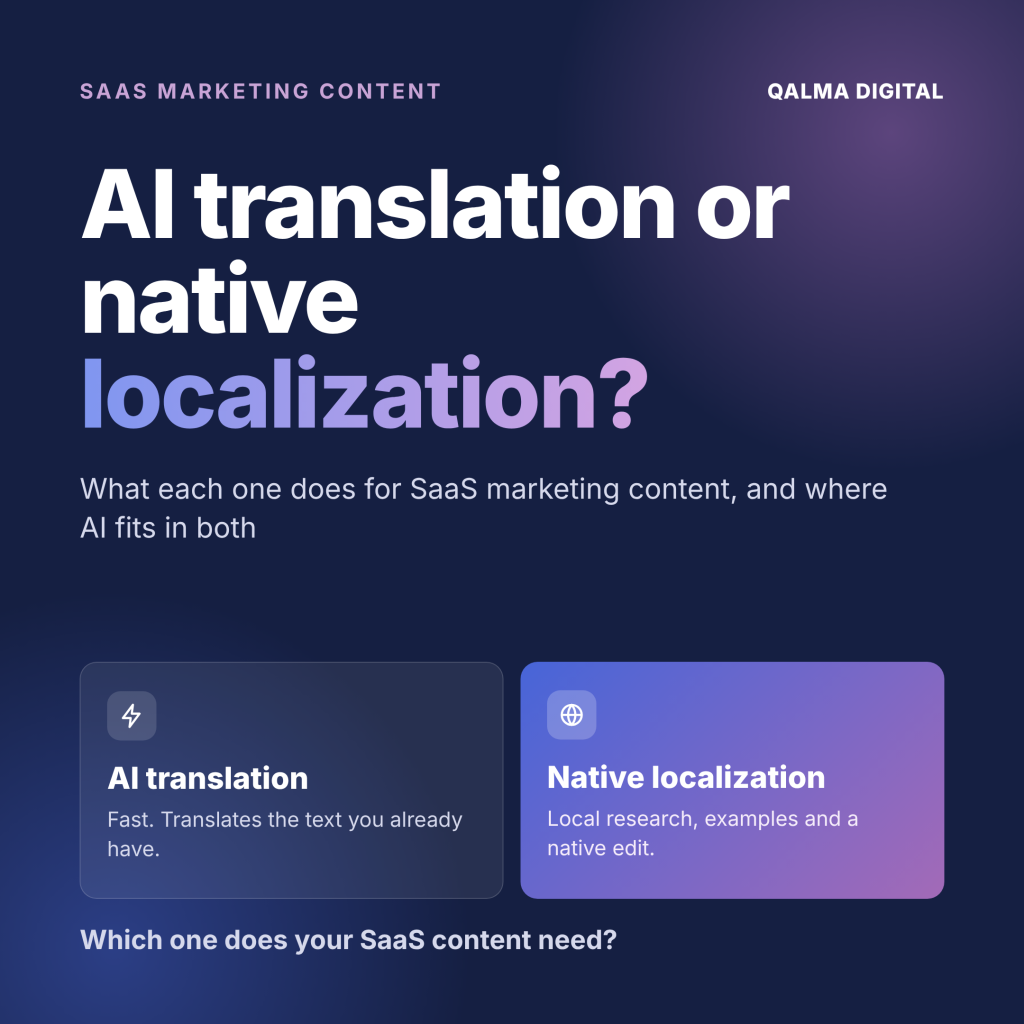
AI translation here means running existing content through a machine translation or AI tool and publishing the output with little or no review. The keywords, structure, examples and sources stay as they were in the original.
Native content localization means a marketer who speaks the target language natively adapts the content for that market, or writes it from scratch when the topic works differently there. Native localizers use AI as well, for first translations, drafts, research and checks. The difference is that someone who knows the market makes the decisions and reviews the result.
Where AI translation does the job
Unreviewed AI translation is a reasonable choice when little depends on the result: internal materials such as onboarding guides for your own team, drafts that someone will rework anyway, or a first test of a market before you invest in content for it.
Customer-facing content is different, even when it isn’t marketing. Help center articles, product UI and onboarding emails shape how new users experience the product, and product terms translated inconsistently from one page to the next confuse them. These pages need at least a native review of terminology, tone and accuracy. Help center articles that answer common questions also show up in search, so they benefit from local keyword research as well.
AI output still needs that review. In Slator’s 2025 survey of 50 enterprise localization buyers, respondents said AI translation quality isn’t yet good enough to skip human review. In Slator’s own tests, GPT-4o produced translations with high general accuracy but a weak, unnatural style, which a native speaker would immediately recognize as unedited machine translation.
Where it falls short for marketing content
Keywords don’t translate one to one
People in each market search with their own terms. The literal translation of an English keyword can be a phrase nobody types, while buyers use a shorter or more colloquial term, or keep the English word. A translated article targets the translated keyword. Only keyword research in the target language shows which term buyers use and what kind of page ranks for it.
The examples and proof come from another market
A translated article keeps the US statistics, US competitors, dollar prices and English sources of the original. A buyer in Germany or Poland comparing tools sees right away that the content wasn’t written for them. Fintech adds another layer: regulations, tax rules and payment methods differ by country, and translating a paragraph about a rule that doesn’t apply in the new market doesn’t make it correct.
Readers notice
Language matters to buyers. In CSA Research’s 2020 survey of 8,709 consumers in 29 countries, 76% said they prefer products with information in their own language and 40% said they don’t buy from websites in other languages. In Germany, 57% buy only from local-language websites, the highest share in the study.
The same survey found that 65% prefer content in their language even if it’s poor quality. So a translated page is better than no page at all. For content that competes with local companies for rankings and leads, though, being understandable is a low bar to aim for.
What Google says about AI-translated pages
Google doesn’t penalize content because AI wrote or translated it. Its guidance on AI content focuses on the quality of content rather than how it’s produced. In June 2025, Google also removed the advice to block automatically translated pages with robots.txt from its documentation, describing it in the Search Central changelog as a docs-only change with no change in behavior.
What Google does act against is scaled content abuse: when “many pages are generated for the primary purpose of manipulating Search rankings and not helping users”, no matter how they’re created. Publishing hundreds of unreviewed translated pages at once to cover a new market can fall into that category.
For most SaaS sites, the more practical risk of mass AI translation is pages that don’t rank. They target terms buyers don’t use and offer nothing that local competitors don’t already have.
Side by side
AI translation | Native content localization | |
Speed | Minutes per article | Longer, because research and editing are part of the work |
Cost per article | Lowest | Higher, depending on research and scope |
Keywords | Translated from the original | Researched in the target language |
Examples, sources, regulations | Kept from the original | Replaced with local ones |
Tone | Accurate, often recognizably translated | Written for readers in that market |
Use of AI | The whole process | Drafts, translation, research and checks |
Best for | Internal materials, drafts, first market tests | Every customer-facing page, with full localization for pages that rank or sell |
For a breakdown of what each option costs, see how much content localization costs.
How to split the work
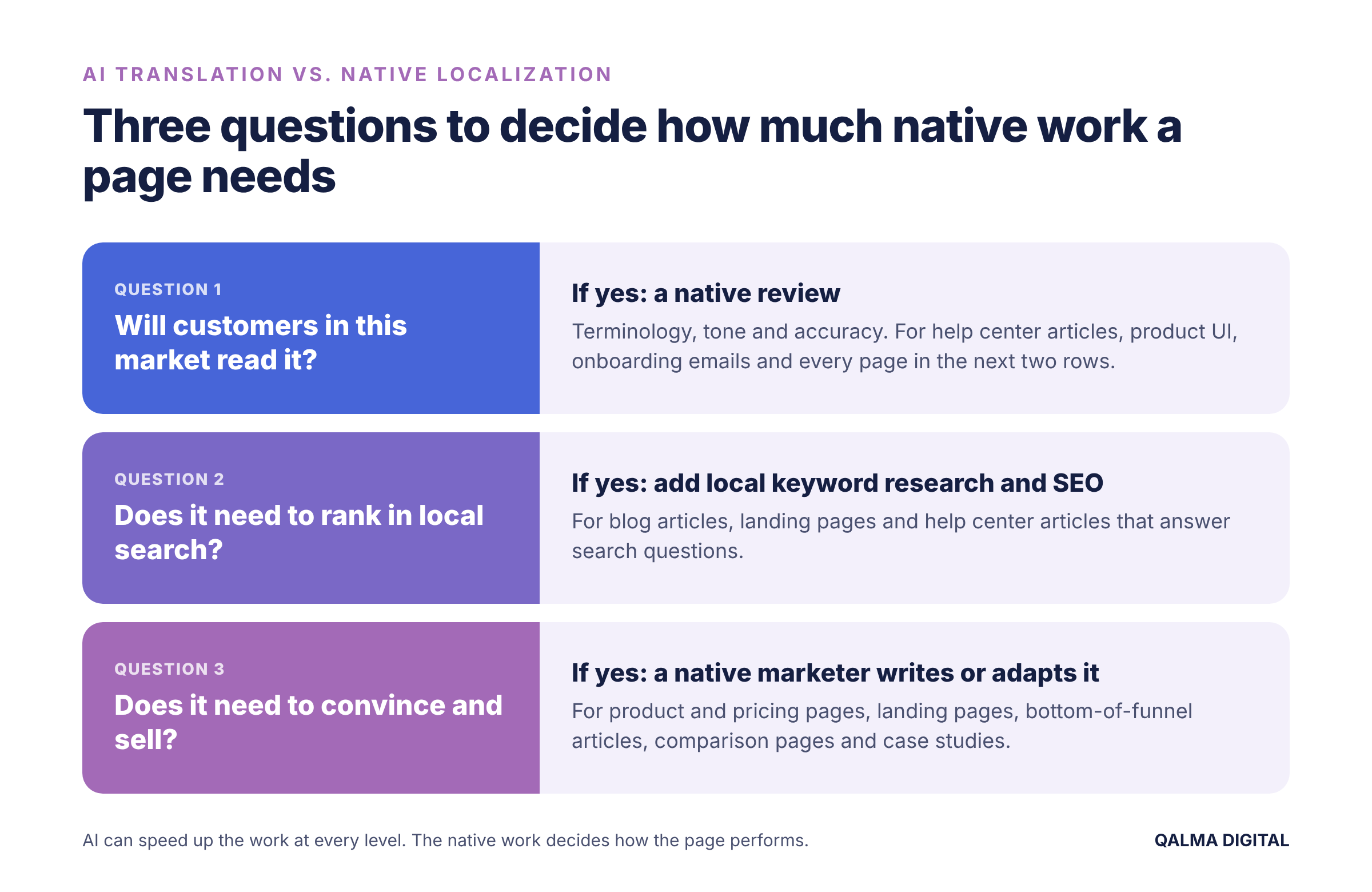
Most SaaS companies don’t need one approach for everything. The useful question for each page is how much native work it needs, and that depends on what the page has to do.
Every page customers read in the new market, including help center articles, product UI and onboarding emails, needs at least a native review of terminology, tone and accuracy. Pages that should rank, such as blog articles, landing pages and help center articles that answer search questions, also need keyword research in the local language. Pages that need to convince and sell, such as product and pricing pages, landing pages, bottom-of-funnel articles, comparison pages and case studies, are best written or adapted by a native marketer from the start. AI can speed up the work at every level.
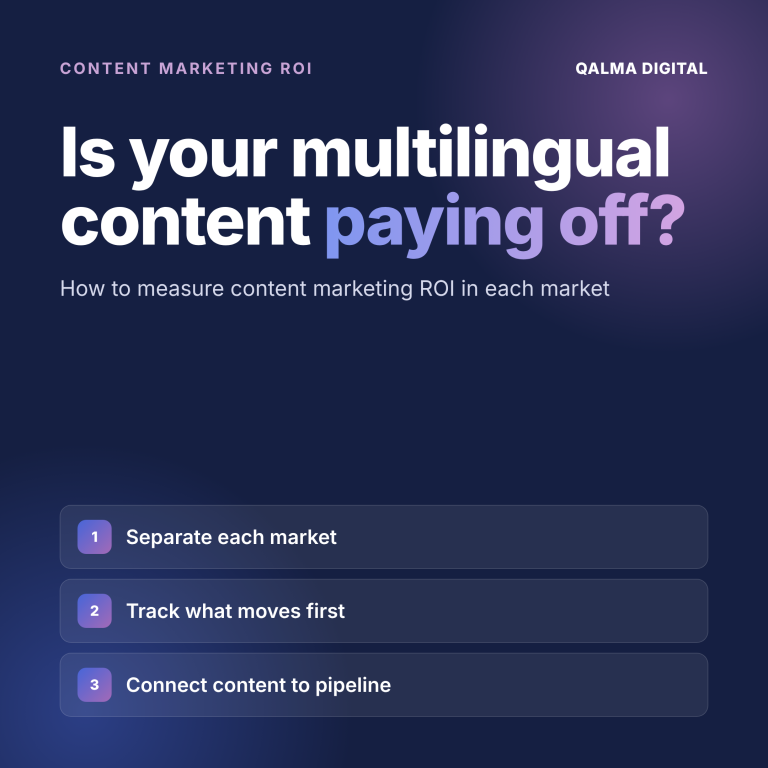
Once the pages are live, track rankings, traffic and leads per market, and adjust how much work each page gets based on what you see. Measuring the ROI of multilingual content covers which numbers to watch.
If you’re choosing an outside partner for the native work, the guide to content localization agencies for SaaS compares the main types of providers and the questions to ask them. If your shortlist also includes SEO agencies, see how to choose an international SEO agency for SaaS.
How to check content you’ve already translated
If you’ve already published AI-translated pages, four checks show whether they need more work:
- Ask a native speaker from your audience, such as a local sales rep or customer, to read your three most important pages and mark anything that sounds translated.
- Search your main keyword in the local Google and compare your page with the pages that rank.
- Check Google Search Console for impressions and the queries each translated page appears for. Pages with almost no impressions are often targeting the wrong terms.
- Look for leftovers from the original market: dollar prices, English sources, US statistics and competitors that don’t sell in the new market.
How Qalma Digital splits the work between AI and native marketers
At Qalma Digital, AI is part of the localization workflow, and how much of it is used depends on the client’s needs. It helps with research, such as summarizing competitor pages and clustering keyword lists. When an existing article is being localized, AI produces the raw first translation, and at the end it helps check grammar, consistency and terminology.
Everything else is done by a native-speaking marketer. They choose which keywords to target based on how people in the market search, and decide whether a topic needs a new article, a localized one or an update. They replace examples, sources and regulations with local ones and rewrite the first translation until it reads as if it had been written in that language. The final edit is theirs too.
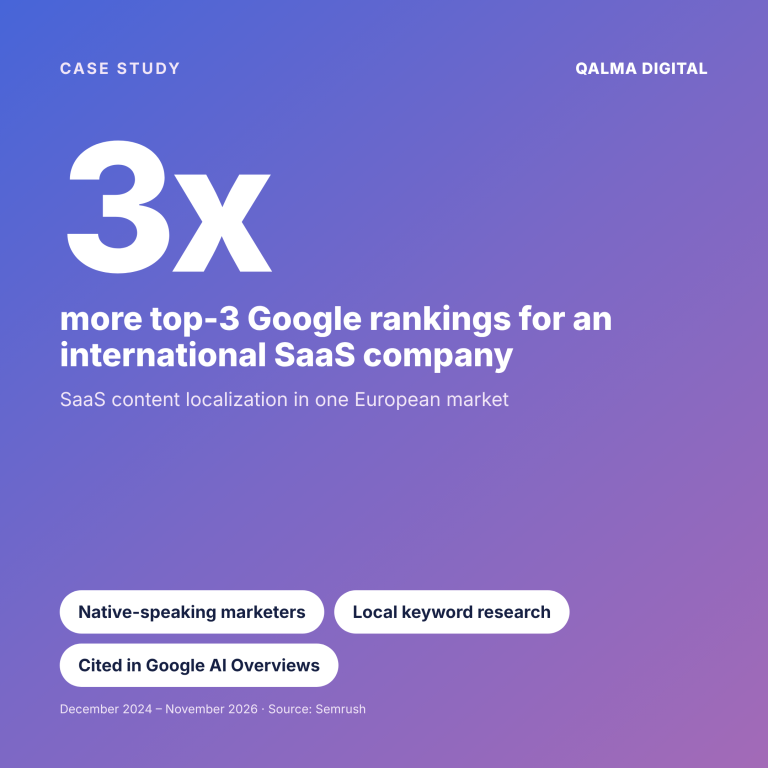
The keyword choice is where the difference shows most. In the SaaS content localization case study, a guide to earning money online ranks for 85 different searches in Hungary, many of them colloquial phrases and spellings without accent marks that a translated keyword list wouldn’t include. More on the workflow and packages: multilingual content writing services.
FAQ
Is AI translation bad for SEO?
Not in itself. Google judges content by its quality, not by how it was produced. The SEO problem with unreviewed AI translation is that the pages often target translated keywords instead of the terms buyers search for, and they rarely add anything local competitors don’t already have.
Do native localizers use AI?
Yes. Translators, writers and agencies use AI for first drafts, translation, keyword clustering and consistency checks. What separates native localization from AI translation is the research, judgment and editing a person who knows the market adds.
Can I start with AI translation and localize later?
Yes. Many teams translate first to test a market, then localize the pages that get traffic or matter most for sales. Start with the pages closest to a buying decision.