Short answer: Content localization for SaaS marketing is priced per word, per project or as a monthly retainer. Per-word translation usually costs 0.08–0.50 a word and covers the language, but usually not keyword research, local sources or SEO in the target market. Project fees depend on the pages, languages and research involved. Monthly retainers cover ongoing research, writing or localizing articles, optimization and reporting, and are usually priced per market.
For a SaaS or fintech company entering a new market, content localization means adapting the marketing content that brings in buyers: blog articles, landing pages, case studies, comparison pages and emails. The goal is content that ranks in local search, shows up in AI answers and reads as if it were written for that market. Localizing the product itself (UI strings, help center, legal pages) is a separate job with its own budget, and this guide doesn’t cover it.
Marketing content localization is priced in three ways: per word, per project or as a monthly retainer. Per-word translation rates usually range from $0.08 to $0.50, depending on the language and how specialized the content is, according to Upwork’s hiring guide for translators. Project fees depend on the number of pages, languages and the research involved. Monthly retainers cover ongoing work in a market: research, writing or localizing articles, updates and reporting.
A per-word quote usually covers the language only. Whether an article ranks and brings in leads in the new market depends on the keyword research, local examples and optimization around it, so two quotes for the same number of articles can describe very different work.
This guide covers what marketing content localization includes, what it brings a SaaS company in a new market, the three pricing models, what drives the price, and what to check before comparing quotes.
What content localization covers in SaaS marketing
Content localization takes content that works in one market and makes it work in another. For a SaaS or fintech marketing team, that usually means:
- Blog articles and guides built around the keywords buyers use in the new market
- Landing and product pages that explain the product with local examples, currencies and regulations
- Case studies with clients and results the local audience can relate to
- Comparison and alternatives pages covering the competitors buyers consider in that market
- Email sequences and sales enablement content for the local sales team
Localization goes further than translation. Keywords are researched in the target language, sources and statistics are replaced with local ones, and the text follows how people in that market search and read. When a topic works differently in the new market, such as invoicing rules or payment habits, the article is usually written from scratch for that market. The guide to content localization agencies explains when to translate, localize, transcreate or write new content.
Why it’s worth budgeting for
Buyers prefer content in their own language. In CSA Research’s 2020 survey of 8,709 consumers in 29 countries, 76% said they prefer to buy products with information in their own language, and 40% said they never buy from websites in other languages. Business buyers show the same preference: in CSA’s survey of 1,116 B2B buyers of technology products, 66% said they’d pay up to 30% more for a localized product.
Organic traffic keeps coming after the budget is spent. Paid search in a new market stops bringing visits when the campaign stops. An article that ranks keeps bringing them, and it can be updated instead of rebought. In the market analyzed in the SaaS content localization case study, the localized blog brings in about a quarter of all non-branded organic traffic, the visitors who didn’t know the brand yet.
Local content can appear in AI answers. Google’s AI Overviews and AI assistants answer questions in the user’s language, and they cite pages written in it. In the same case study, the blog’s article for its highest-volume target keyword is cited in Google’s AI Overview and ranks #2 in the results below it.
Sales gets material in the buyer’s language. Case studies, comparison pages and guides in the local language give the sales team something to send before and after a call, instead of English content the buyer has to read in a second language.
How much of this a provider delivers depends on what the quote covers. That’s where the three pricing models differ.
The three pricing models
Per word
Per-word pricing is the standard in the translation industry. In Slator’s 2024 market research, 91% of language service providers said they still use per-word rates, 64% charge by the hour for certain types of work, and 14% charge per document.
Upwork’s guide gives these typical per-word ranges:
Content type | Typical rate per word |
Common language pairs | 0.08–0.15 |
Less common languages | 0.15–0.25 |
Specialized content (legal, medical, technical) | 0.25–0.50 |
A per-word rate covers translating the text you already have, sometimes with a second linguist reviewing it. Keyword research in the target language, local examples and sources, and on-page SEO are usually outside the scope, or quoted separately.
Best for: marketing content that has already been adapted for the market and only needs accurate language, or content that doesn’t need to rank, such as transactional emails, release notes and in-app messages.
Per project
Project pricing works for work with a clear end: localizing a set of landing pages for a market launch, adapting a campaign, or translating a website before it goes live in a new country. The quote is built from the page count, the number of languages, how much research each market needs and how many review rounds are included.
Agencies often estimate these projects from hourly rates. Content marketing agencies listed on Clutch charge 100- 149 an hour on average, with rates varying widely by country.
Best for: market launches, website localization and campaigns with a fixed scope and deadline.
Monthly retainer
A monthly retainer pays for ongoing work in one or more markets: keyword and competitor research, new articles, localization of existing content, updates to pages that already rank, and reporting. The scope is usually defined by the number of articles or pages per month and the number of markets.
There’s little public pricing data for multilingual content retainers specifically. The closest benchmark is SEO: in Ahrefs’ survey of 439 SEO providers, agencies charged $3,209 a month on average, and freelancers $1,349. Ahrefs calculated these averages from the top of each respondent’s price range, so they lean high.
Best for: SaaS and fintech companies that want organic traffic and leads from a new market, and need content to keep working after it’s published.
What drives the price
Within each model, a few factors move the number up or down.
The language and the market. Common language pairs cost less per word than less common ones. Markets with stronger local competition also need more research before the first article is planned.
How specialized the content is. Fintech content that touches regulation, or SaaS content that explains a complex product, takes more time to get right than general marketing copy. In translation pricing, specialized content sits at the top of the range.
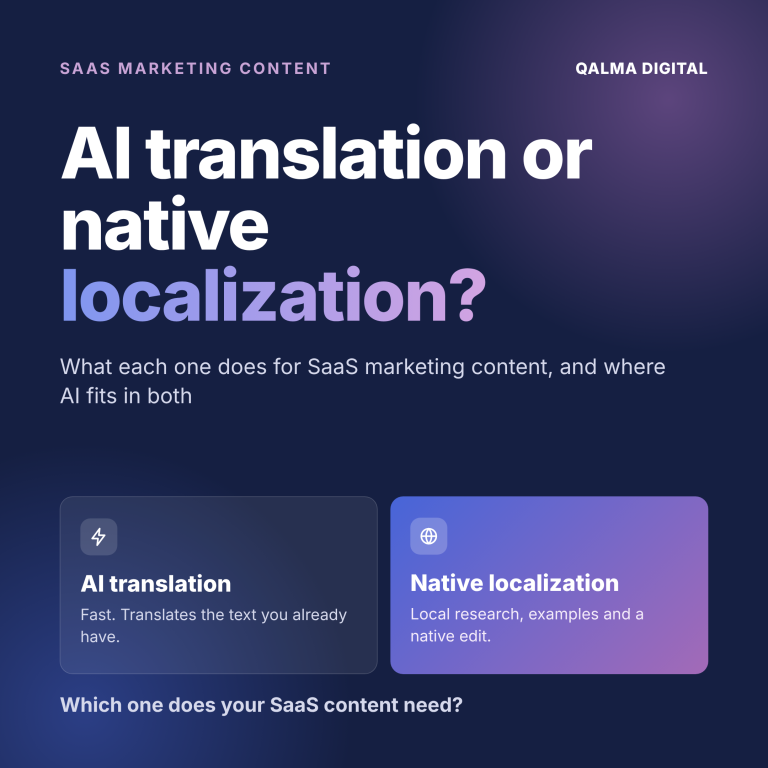
Translation, localization or new content. Translating an existing article is the cheapest option per piece. Localizing it with local keywords, examples and sources costs more, and writing a new article for the market costs more again. For how these approaches compare in practice, see AI translation vs. native content localization.
Research and SEO. Local keyword research, competitor analysis and on-page optimization add time per piece, and they’re the part that decides whether the content ranks in the new market.
Volume and the number of markets. Retainers and projects usually get cheaper per piece as volume grows, but each new market brings its own research.
Updates. Content that ranks needs updating as search results, competitors and AI answers change. Some providers include updates in the retainer, others bill them as new work.
How AI changes the cost
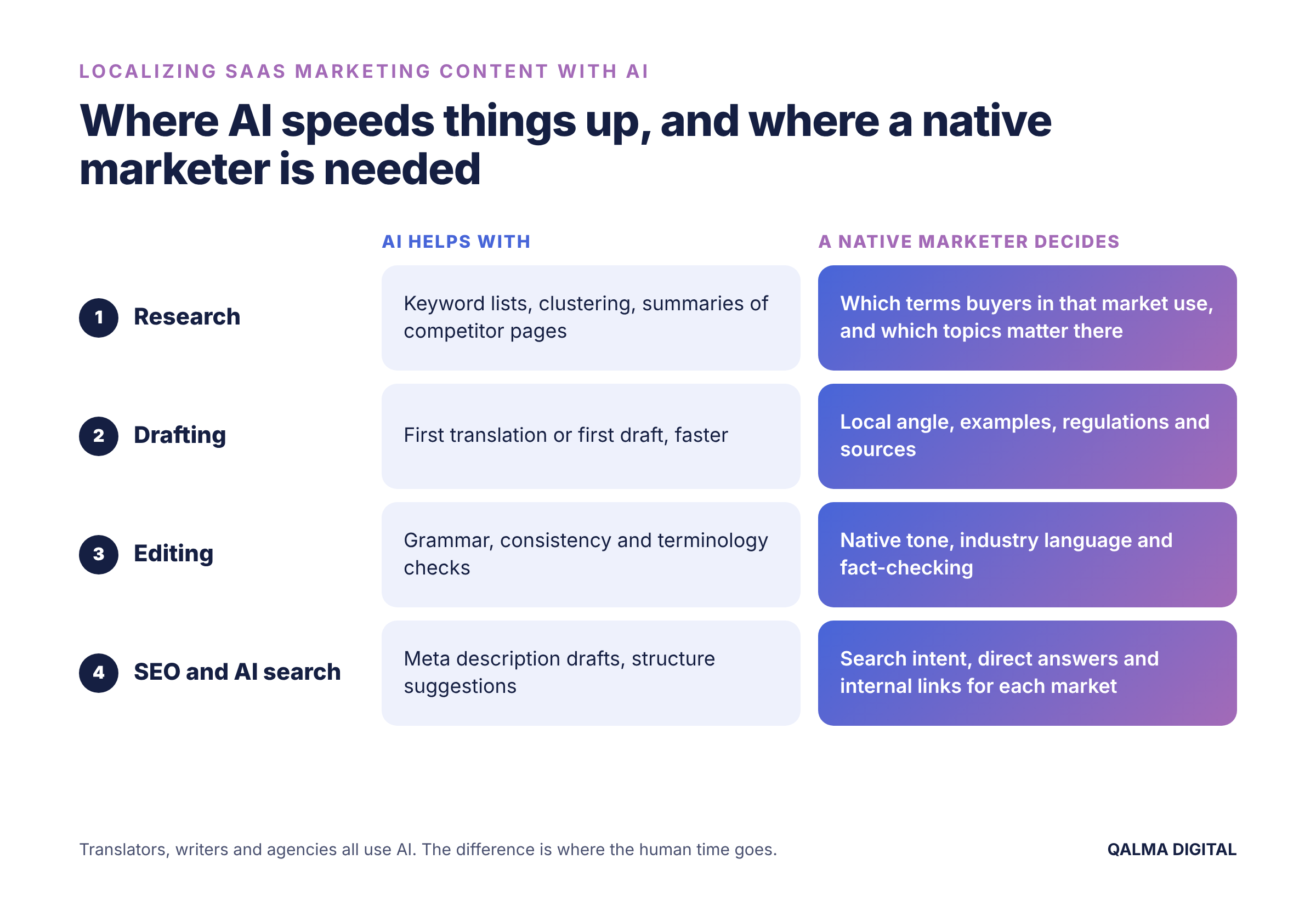
AI has changed how content localization is done. Translators, writers and agencies use it for first translations, first drafts, keyword clustering, summaries of competitor pages and consistency checks. Work that used to take days can take hours.
The per-piece price reflects this. In Ahrefs’ 2025 survey of 879 marketers, an AI-generated blog post cost $131 on average, and a human-written one $611. Total budgets moved less: marketers who used AI spent 2,475amonthoncontentonaverage,almostthesameasthosewhodidn’t(2,442), and 45% of AI users said they weren’t saving money.
What AI doesn’t do on its own is decide what a market needs: which terms buyers in that country search for, which competitors and regulations to mention, which examples will make sense to a local reader, and whether the text sounds like someone from the industry wrote it. That part still needs a person who knows the market and the language. Google’s guidance points the same way: it focuses on the quality of content rather than how it’s produced, and content generated mainly to manipulate rankings breaks its spam policies.
So when you compare quotes, ask how the provider uses AI and how much of the price pays for research, writing and editing by someone who knows the market.
A worked example: one market, one month
Say a SaaS company wants four long-form blog articles a month, about 2,500 words each, for its first market in Germany. That’s around 10,000 words a month.
Per-word translation of existing English articles: at 0.08–0.15 per word for a common language pair, that’s roughly 800–1,500 a month. The articles keep their English keywords, examples and sources unless someone adapts them.
A monthly content retainer: the price includes research in the German market, writing or localizing the articles for German search, local sources and examples, on-page SEO and reporting. For reference, Qalma Digital’s packages for multilingual content writing services start at $3,000 a month for one market, including four long-form articles. Other agencies price differently, so it’s worth comparing what each quote includes.
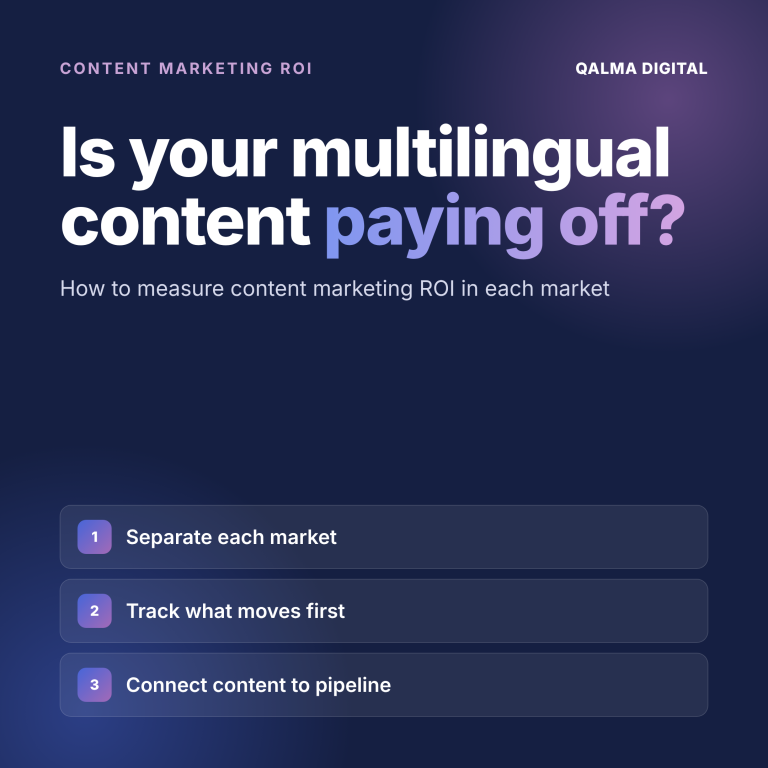
The gap between the two numbers is the research and optimization work. Whether that work is worth paying for depends on how much the market’s pipeline relies on organic search. How to measure the ROI of multilingual content covers how to work that out.
What doesn’t show up in the quote
The lowest quote can still turn out to be the most expensive one, because some costs land on your own team.
- Review time. If translated content needs heavy editing by someone on your team who speaks the language, that time is part of the price.
- Terminology fixes. Product and industry terms translated inconsistently across articles need cleanup later.
- Pages that don’t rank. Content that targets keywords nobody searches for in the new market brings little traffic, and the gap gets filled with paid ads.
What Qalma Digital’s packages include
Qalma Digital’s monthly packages for multilingual content writing services are built around the questions above. Keyword and competitor research is done in the local language for each market, and the articles are written by native-speaking marketers. Depending on the client’s needs, AI helps with research, first translations and checks, while the native marketer decides what goes into each article, replaces examples and sources with ones from the target market and does the final edit.
On-page SEO, GEO and AEO are part of every article, along with up to two rounds of revisions and updates to articles already delivered. Each package also includes a content audit, a three-month content plan, a monthly report and a dedicated project manager.
The Starter package starts at $3,000 a month for one market and four long-form articles. Growth starts at $6,000 a month for two or three markets, with eight articles a month across them, and four or more markets are priced individually. Any new article in a package can be swapped for two localized ones, and packages run for a minimum of three months. The package comparison lists everything included.
How to compare quotes
Two quotes for “localizing four articles a month” can describe very different work. Before you compare prices, ask each provider:
- Is keyword research done in the target language, or are the English keywords translated?
- Who writes the content: native-speaking marketers or translators?
- Are local examples, statistics and sources replaced, or kept from the original?
- Is on-page SEO included, and is the content structured for Google’s AI Overviews and AI search tools?
- How many revision rounds are included?
- Are updates to published content part of the fee?
- What does each additional language or market cost?
- Is there a minimum contract term?
For a full comparison of providers and the questions to ask before signing, see how to choose a content localization agency. If your shortlist also includes international SEO agencies, this guide to choosing an international SEO agency for SaaS covers what to look for.
FAQ
Is per-word pricing cheaper than a monthly retainer?
Per word, yes. Per result, it depends on the content. For documentation, per-word translation is usually the most efficient option. For content that has to rank and bring in leads, a per-word quote often leaves out the research and SEO work, which then falls to your team or doesn’t happen.
How much does it cost to localize one blog article?
Translating a 2,500-word article at 0.08–0.15 per word costs around 200–375 for a common language pair. Localizing it with local keyword research, examples and SEO costs more, and writing a new article for the market costs more again. A human-written blog post cost marketers $611 on average in Ahrefs’ 2025 survey.
Do I pay separately for each language?
Usually, yes. Each language and market needs its own research, writing or adaptation, and review. Some providers discount additional markets in a monthly package.
What results can I expect for the money?
It depends on the market, the competition and the content, so any fixed promise would be a guess. How to measure the ROI of multilingual content explains how to track the results in each market, and the SaaS content localization case study shows what two years of localized content achieved in one small market.