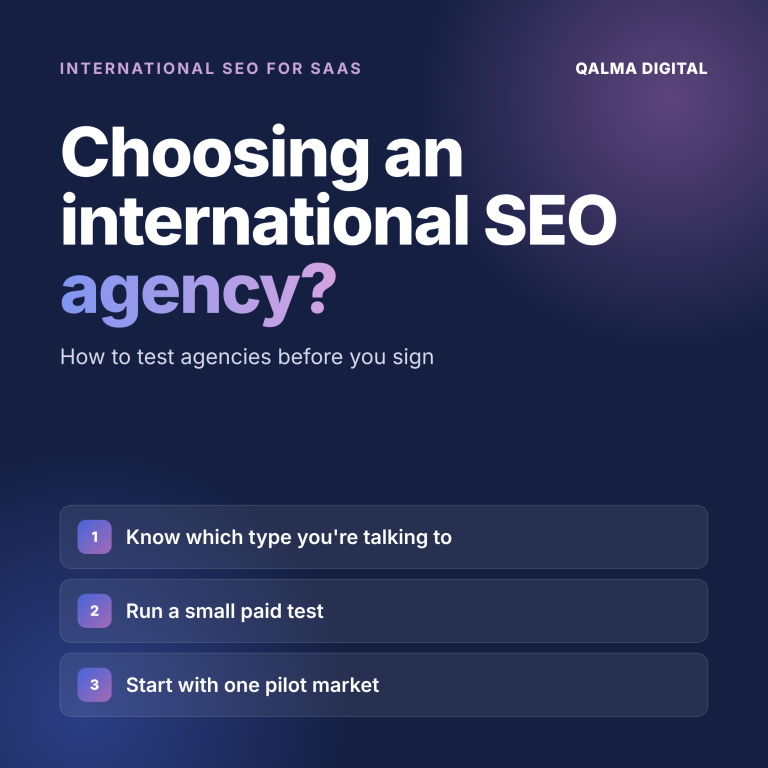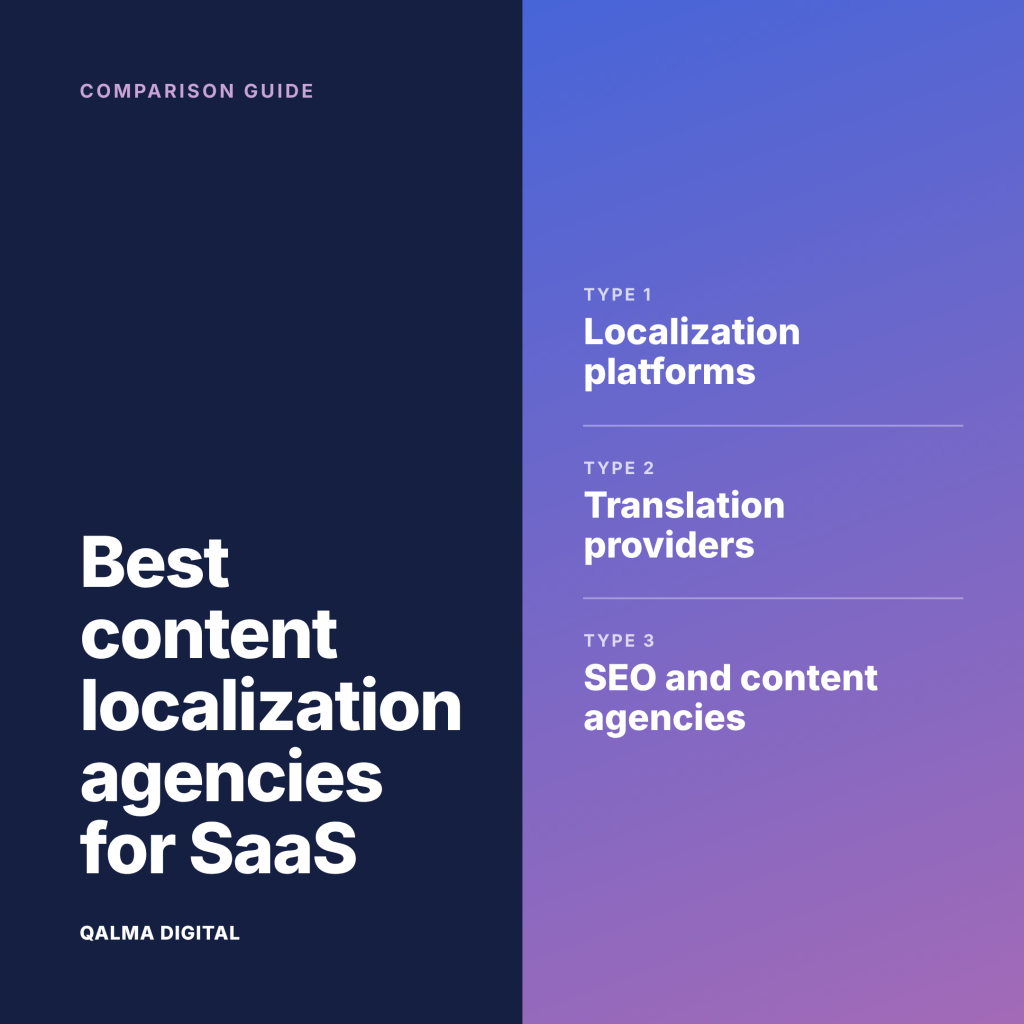
Short answer: The best content localization agency for a SaaS company depends on the job. Localization platforms such as Lokalise, Phrase and Crowdin manage translation workflows for product and help content. Translation providers such as BLEND, Milengo and Locaria translate large volumes in many languages. SEO and content agencies such as Qalma Digital, Flying Cat Marketing, Skale, Omniscient Digital and TripleDart research each market and write content that ranks and brings in leads. First decide what the content needs to do. Then compare agencies within that category.
You have a new region on next year’s plan. Maybe it’s DACH, Iberia, LatAm or Central and Eastern Europe. Your English site converts, your content engine works, and leadership expects the new market to start contributing pipeline within a few quarters.
Then comes the question that rarely gets enough time in the planning: who’s going to produce content for that market?
You’ll probably hear three very different pitches. A localization platform that promises to automate the process. A translation provider that covers more than 100 languages. And an SEO and content agency that wants to research the market and write for it from scratch. Each of them solves a real problem, just a different one. When the option doesn’t match the goal, it can take two quarters to show: the localized pages are indexed, the traffic report looks fine, and pipeline from the new region is still close to zero.
This guide helps you sort through the options. It covers the three types of partners, what organic content can save you, and the agencies SaaS teams shortlist most often, Qalma Digital included.
In this article:
- The 3 types of content localization partners
- What organic content saves you in a new market
- Translation, localization, transcreation or new content?
- The best content localization agencies for SaaS companies
- How Qalma Digital approaches SaaS content localization
- Questions to ask before you sign
- 4 common mistakes when SaaS companies localize content
Planning a launch in a new market? Get in touch
The 3 types of content localization partners
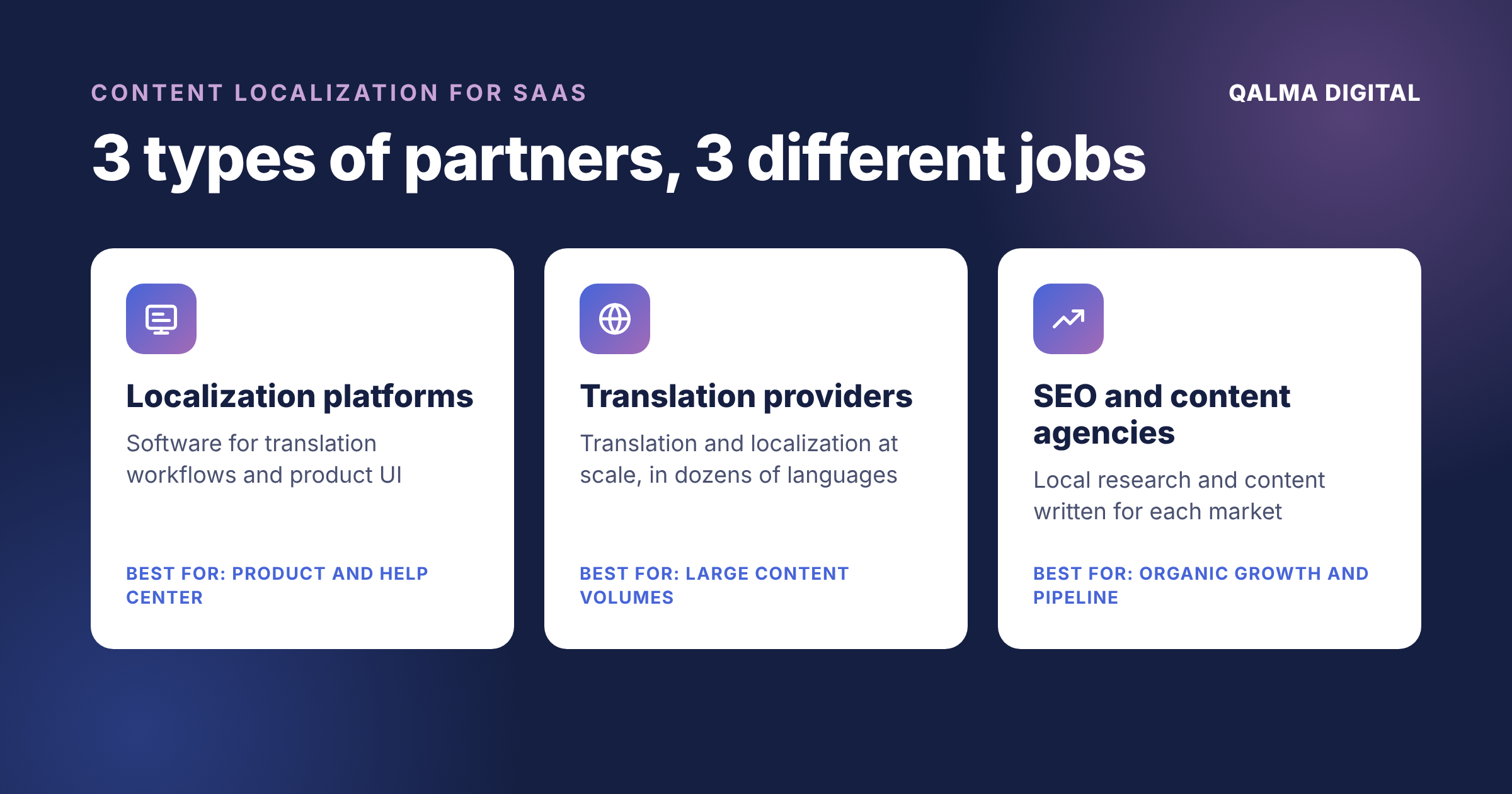
These providers do fundamentally different jobs, so a comparison only makes sense within the same category. Before you look at individual agencies, it helps to know which category you’re shopping in.
|
Localization platforms |
Translation and localization providers |
SEO and content agencies with localization |
|
|
Examples |
Lokalise, Phrase, Crowdin |
BLEND, Milengo, Locaria |
Qalma Digital, Flying Cat Marketing, Skale, Omniscient Digital, TripleDart |
|
What you get |
Software to manage translation workflows, translation memory and machine translation |
Translation, localization and transcreation at scale, often in dozens of languages |
Market research, local keyword research, content strategy and content written for each market |
|
Best for |
Product UI, help centers and documentation that change often |
Large volumes of existing content across many languages |
Organic growth and pipeline in a few priority markets |
|
Keep in mind |
You still need people to write or translate |
Work usually starts from your existing source content |
Most cover fewer languages than large translation providers |
The three can work together. A platform can handle the product and help center, a translation provider the documentation, and a partner for multilingual content writing services the website and blog in the two or three markets that matter most this year.
What organic content saves you in a new market
When a new region goes live, paid search is the fastest channel to switch on. But every lead costs as much in month twelve as it did in month one, and the flow stops when the budget does. Organic content works the other way around: the upfront investment is higher, and every article that ranks keeps bringing in leads without a cost per click.
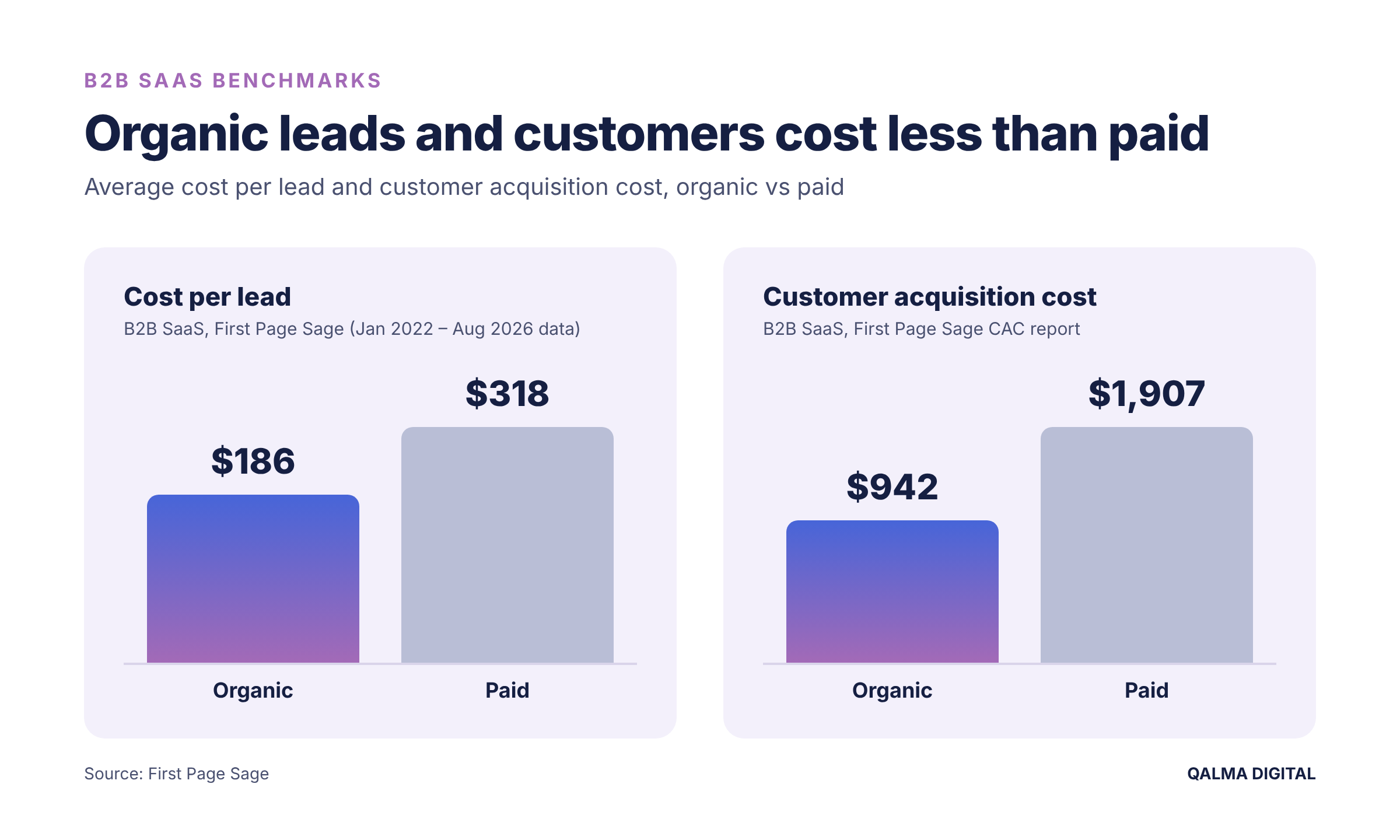
The benchmarks show how wide the gap gets:
- Cost per lead: Based on lead generation data from January 2022 to August 2026, First Page Sage puts the average organic lead for B2B SaaS at $186, compared with $318 for a paid lead. That’s around 40% less.
- Customer acquisition cost: First Page Sage’s B2B SaaS CAC report puts average organic CAC for B2B SaaS at around $942, against $1,907 for paid.
Client data points the same way. In the market from our SaaS content localization case study, Semrush estimates that the blog’s organic traffic would cost around $670 a month to buy through Google Ads, in a country of fewer than 10 million people. The client gets that traffic every month without a media budget.
AI search follows the same logic. When ChatGPT or Google’s AI Overview recommends your brand, there’s no click to pay for.
Organic content does take longer to pay back, so paid campaigns are useful for testing messaging early, while organic builds the market’s long-term pipeline. The savings also depend on the content itself: it has to rank in the local market and reach buyers who are close to a decision. That’s the job of SaaS content marketing built for each market.
Translation, localization, transcreation or new content?
These four terms get used interchangeably, but they describe different work, with different costs and different results.
|
What it means |
Use it for |
|
|
Translation |
Converting text into another language while keeping the meaning |
Legal pages, documentation, product UI |
|
Localization |
Adapting content to a market: local keywords, examples, sources, regulations and references |
Blog content, help content, landing pages |
|
Transcreation |
Recreating a message for a new culture, keeping its intent and effect rather than its wording |
Taglines, campaigns, brand messaging, ads |
|
New content |
Writing from scratch for a market, based on local research |
Topics tied to local rules, habits or search behavior |
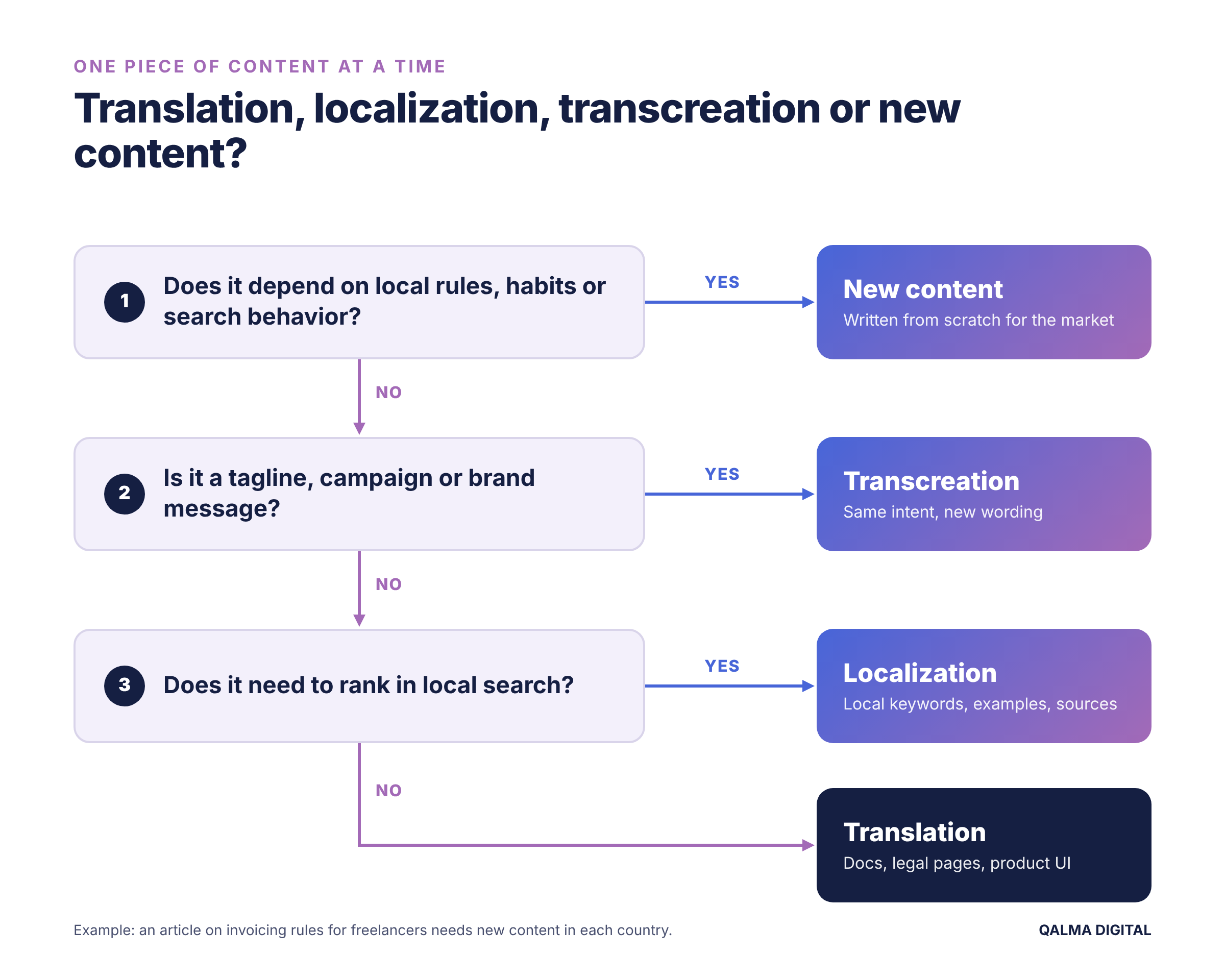
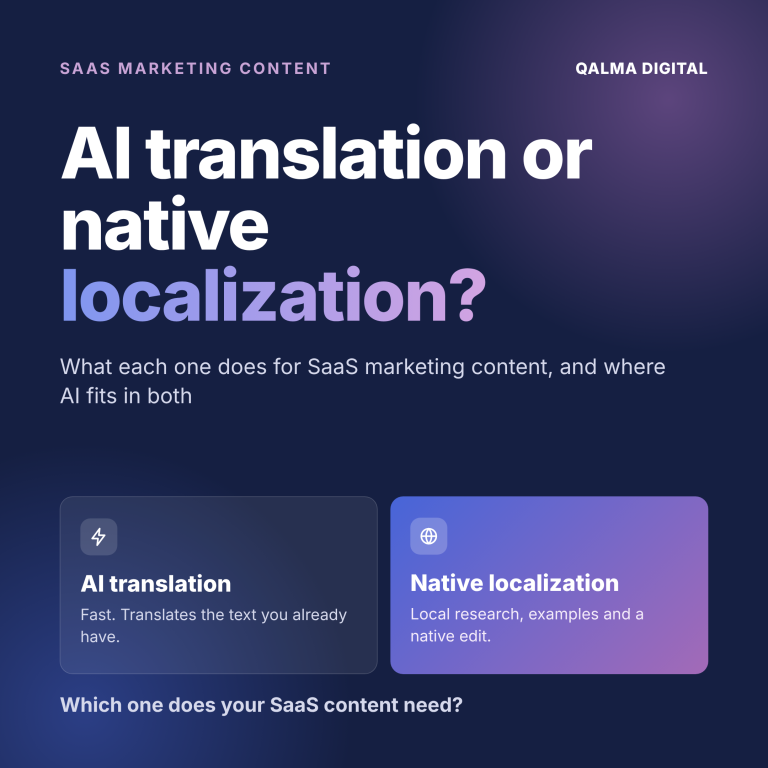
In practice, a content program in a new market uses all four, and the decision is made topic by topic. A guide to your product’s integrations might only need careful localization. An article on invoicing rules for freelancers has to be written for each country, because the rules themselves are different. AI translation vs. native content localization explains how much native work each type of page needs.
The best content localization agencies for SaaS companies
The list includes agencies with proven SaaS experience, native-language or in-market capabilities and publicly available information about their services and clients. It covers both SEO and content agencies and translation and localization providers, since many SaaS teams compare the two.
|
Agency |
Type |
Best for |
Languages and markets |
|
Qalma Digital |
SEO and content agency |
SaaS and fintech teams that need native BOFU content in each market |
10 languages: English, Spanish, Portuguese, German, French, Italian, Polish, Hungarian, Romanian and Turkish |
|
Flying Cat Marketing |
SEO and content agency |
Mid-market B2B SaaS with budgets for a full international SEO program |
Distributed team, B2B SaaS clients |
|
Skale |
SEO agency |
SaaS companies that want their entire SEO channel managed |
English and Spanish |
|
Omniscient Digital |
Organic growth agency |
B2B software companies focused on revenue-driven organic growth |
30+ people across 10 countries |
|
TripleDart |
Full-service SaaS marketing agency |
SaaS teams that want SEO, paid media and other channels under one roof |
US and UK markets |
|
Locaria |
Multilingual content agency |
Global brands running campaigns across many markets at once |
Talent network of 1,400+ specialists |
|
Milengo |
Language services provider |
Software localization combined with marketing translation |
120+ languages |
|
BLEND |
Localization and translation provider |
High volumes of translation across many languages |
120+ languages |
1. Qalma Digital
Best for: SaaS and fintech teams that need native, bottom-of-the-funnel content in each market, written by people who understand both the product and the local buyer.
Qalma Digital is a founder-led agency for SaaS and fintech content marketing, working with both B2B and B2C companies. Founder Csilla Huszárik worked in IT business development before starting the agency in 2018 and still leads content strategy, so the person planning your content speaks your product team’s language as fluently as your buyers’. The agency’s specialty is turning technical features and jargon into the benefits and solutions that move buyers toward a decision.
Every writer is a native-speaking marketer. The agency covers 10 languages: English, Spanish, Portuguese, German, French, Italian, Polish, Hungarian, Romanian and Turkish, and adapts content to the specific country for languages spoken in several markets. Its work spans bottom-of-the-funnel content, international SEO and content structured for AI search, along with web copy, email campaigns, PR articles and award submissions. Packages start at $3,000 a month for one market.
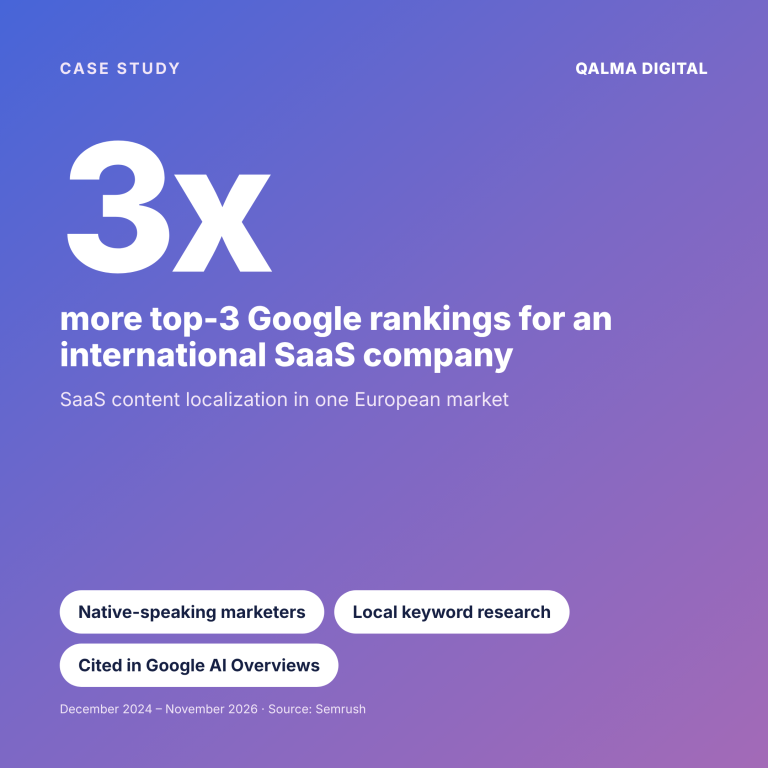
For an international SaaS client, Qalma’s blog content tripled the number of top-3 Google rankings in one of its markets, from 7 to 21 keywords. The blog brings in about a quarter of the market’s non-branded organic traffic and ranks #2 for its highest-volume target keyword, with a citation in Google’s AI Overview. See how the blog tripled its top-3 rankings →
2. Flying Cat Marketing
Best for: Mid-market B2B SaaS companies with budgets for a full international SEO program.
Flying Cat Marketing is an SEO and content marketing agency for fast-growth B2B SaaS companies, with a fully distributed team. Its founder worked as a freelance content marketer, copywriter and translator for 10 years before starting the agency, and clients have included Hotjar, ActiveCampaign and Mixmax. According to its Clutch profile, hourly rates are 100–149.
3. Skale
Best for: SaaS companies that want an agency to run their entire SEO channel.
Skale is a London-based organic growth agency for SaaS and tech brands, founded in 2019. It describes itself as AI-search-first, and its Clutch profile lists English and Spanish as its languages and a minimum project size of $5,000.
4. Omniscient Digital
Best for: B2B software companies that want organic growth tied to pipeline and revenue.
Omniscient Digital is an organic growth agency working with B2B software companies on SEO, answer engine optimization, content and digital PR. It has built organic growth programs for companies such as SAP, Asana, Loom, Hotjar and Jasper, with a team of more than 30 people across 10 countries.
5. TripleDart
Best for: Growing SaaS companies that want SEO alongside paid media, ABM and other channels.
TripleDart is a remote-first B2B SaaS marketing agency founded in 2020 and headquartered in the US, serving US and UK markets. Its services span SEO, PPC, account-based marketing, conversion rate optimization, web design and revenue operations, for SaaS companies from seed stage to enterprise.
6. Locaria
Best for: Global brands that need multilingual campaigns across many markets at once.
Locaria is a multilingual content agency within the Stagwell network. It offers transcreation, multilingual SEO, paid media localization and cultural consultancy, along with AI-assisted translation with post-editing. Its core team of 147 people works with a talent network of more than 1,400 specialists.
7. Milengo
Best for: SaaS companies that need product and software localization alongside marketing translation.
Milengo is a language services provider with more than 30 years in the localization industry, working with software, IT and manufacturing companies. It offers software localization, AI-assisted translation with human review and terminology management in 120+ languages. Clients include Snowflake, Infor and Precisely.
8. BLEND
Best for: Companies that need large volumes of content translated into many languages.
BLEND, formerly One Hour Translation, is a localization provider founded in 2008 and headquartered in Tel Aviv. It combines AI and human translation across 120+ languages, with services including website and app localization, multilingual SEO and voice-over.
How Qalma Digital approaches SaaS content localization
Every engagement follows the same sequence, and it starts with your product. Content that gets the product wrong won’t convert in any language.
Product first
The work starts with your documentation, hands-on time in the product and a map of how your sales team positions it. By the time the first article is planned, it’s clear which features matter to which buyers, and why.
Interviews with your experts
Conversations with your product managers, sales and customer success teams surface the objections buyers raise, the use cases that close deals and the details your competitors can’t copy from the top 10 search results.
Market and competitor research
In every new market, you compete with local players who already write for that audience. Before a content plan is set, the research shows who ranks for your priority topics, what they cover well and where the gaps are.
Keyword research in the local language
Each market gets its own research. For example, buyers in Spain and Mexico don’t always use the same words for the same product, and Brazilian and European Portuguese also need separate research. As a result, the keyword list often includes colloquial phrases and spellings without accent marks that a translated list would miss.
Native-speaking marketers write the content
The writers know how people in their market talk about the problem today, which local tools buyers compare you to and which examples they’ll recognize. Depending on the topic, they localize existing content or write new articles from scratch, and the result reads as if it had been written in that language from the start. A content strategist reviews every piece for accuracy, brand voice and SEO before it reaches your team.
Features turned into benefits and solutions
This is Qalma’s strongest point. Technical products tend to be described in the language of the people who build them, while buyers search for the problems they need to solve. Each capability is explained through the outcome it delivers, in terms a marketing manager, a founder or a finance lead can act on. That’s also why the focus is on bottom-of-the-funnel content, such as comparisons, alternatives, use cases and buying guides, where readers are already weighing a decision.
Visibility on Google and in AI answers
Every piece combines international SEO and internal linking with a structure that ChatGPT, Perplexity and Google’s AI Overviews can cite. Rankings and AI citations are tracked separately for each market.
Web copy, email and PR for each market
The same team writes localized web copy, email campaigns, PR articles and award submissions, so your messaging stays consistent from the first search to the signup.
Monitoring, updates and optimization
Rankings, non-branded traffic, AI citations and leads are tracked continuously and reported monthly for each market. The data decides the next step. Articles that lose positions or carry outdated information get updated. Topics and formats that bring in leads get more content. When search behavior, competitors or AI answers change, the plan changes with them.
Questions to ask before you sign
Before you sign with a content localization agency, ask these five questions. They cover results, the team, the use of AI, the first 90 days, and pricing, so you can compare the answers side by side.
1. Can you show results in a market like ours?
Ask for rankings, non-branded traffic or leads from a comparable market, not writing samples alone.
2. Who will work on our account month to month?
Meet the strategist and writers, and ask whether the same people stay on your account.
3. Where do you use AI, and who reviews the output?
If an agency uses AI in its process, you should know where, and who is accountable for accuracy.
4. What happens in the first 90 days?
A good partner can tell you when research ends, when the first content goes live and when you should expect to see movement.
5. How do you price, and what’s included?
Check whether strategy, keyword research, link building and reporting are part of the fee or billed separately. For typical price ranges and what drives them, see how much content localization costs.
4 common mistakes when SaaS companies localize content
In our work with more than 100 clients since 2018, we’ve seen the same four mistakes when SaaS companies enter a new market. The good news is that they’re easy to avoid. It helps to decide early which pages to localize first, which keywords to target and how you’ll measure success.
Localizing the blog and leaving the money pages behind
A strong local article that sends readers to a translated pricing or product page loses them at the point of conversion. Localize the product, pricing and landing pages before the blog starts sending traffic to them.
Reading total traffic instead of non-branded traffic
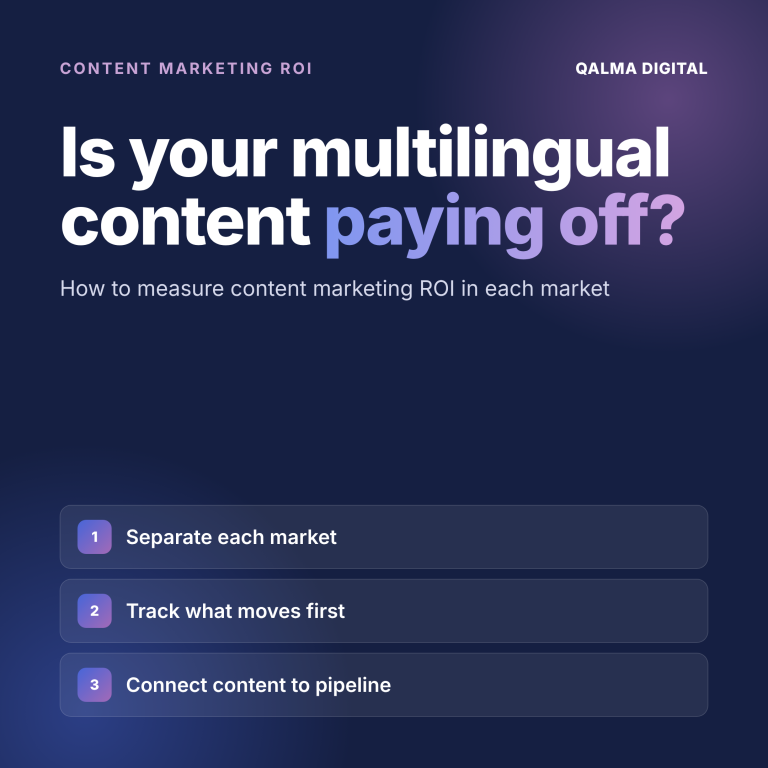
In the market from our case study, around two thirds of organic visits come from people searching for the brand name or the login page. If you only look at the total, you can’t tell whether your content brings in new users at all. How to measure the ROI of multilingual content explains how to separate the two.
Translating the English keyword list
Buyers in each market search with their own terms: colloquial phrases, English words they keep, spellings without accent marks. An article built on a translated keyword can be accurate and well written and still rank for searches nobody makes. Keyword research has to start in the target language.
Treating localization as a one-off project
Search behavior changes, competitors publish and AI answers shift. In our client work, a large share of growth comes from updating articles that already rank, so plan budget for maintenance from day one.
Match the partner to the markets you’re entering
For large volumes of translation into many languages, a translation provider is the efficient choice. To localize your product and keep it in sync, start with a platform. However, if you need organic growth and pipeline in a few priority markets, look for a partner with native writers in those markets, research behind every piece and results you can verify. Also, if your shortlist includes SEO agencies, see how to choose an international SEO agency for SaaS.
FAQ
What does a content localization agency do?
A content localization agency adapts or creates content for a specific market. Depending on the agency, that ranges from translating existing content to researching the market and writing new content in the local language.
How much does a content localization agency cost?
It depends on scope. SEO agencies charged $3,209 a month on average in Ahrefs’ survey of 439 SEO providers, and larger international SEO programs can reach six figures per project. Translation providers usually price per word or per project. Qalma Digital’s packages start at $3,000 a month for one market.
Is AI translation enough to localize SaaS content?
For documentation and frequently updated product content, AI translation with human review can work well. Content meant to rank and win customers in a new market needs local keyword research, local examples and knowledge of the market. Google’s guidance on AI content focuses on the quality of content rather than how it’s produced. AI translation vs. native content localization shows where each approach fits.
How long does content localization take to show results?
New content usually needs several months to rank on Google. Visibility in AI answers can respond faster, and updates to existing articles often show results sooner than new ones.
Planning your next market?
Qalma Digital writes and localizes SaaS and fintech content in 10 languages: English, Spanish, Portuguese, German, French, Italian, Polish, Hungarian, Romanian and Turkish. Tell us where you’re expanding. After a short discovery call, you’ll get a proposal with the markets, content types and pricing that fit your plans.